

When the Fourth Industrial Revolution has officially come in this era of modernization, a fast-changing global economy ubiquitously poses in every spectrum of human living standard. Professor Klaus Schwab (The Fourth Industrial Revolution, para. 2), Founder and Executive Chairman of the World Economic Forum persuaded that “we are at the beginning of a revolution that is fundamentally changing the way we live, work and relate to one another.” The world keeps changing out there while millions of vulnerable and miserable human lives are still struggling to just seek asylums or even a just proper land but not home to live to stay away from wars, conflicts and risks of persecution in anywhere in this globe. This makes us think how we as the one human community can pace this step of modernization without adequate cares to other lives at the heart of a humanitarian. In this writing, the role of community engagement, the advocacy and the human dignity will altogether address without any demur as important keynotes to all of the human connections at the ground of the common good in order to hope and bring basic components for any better changes amongst human societies worldwide.

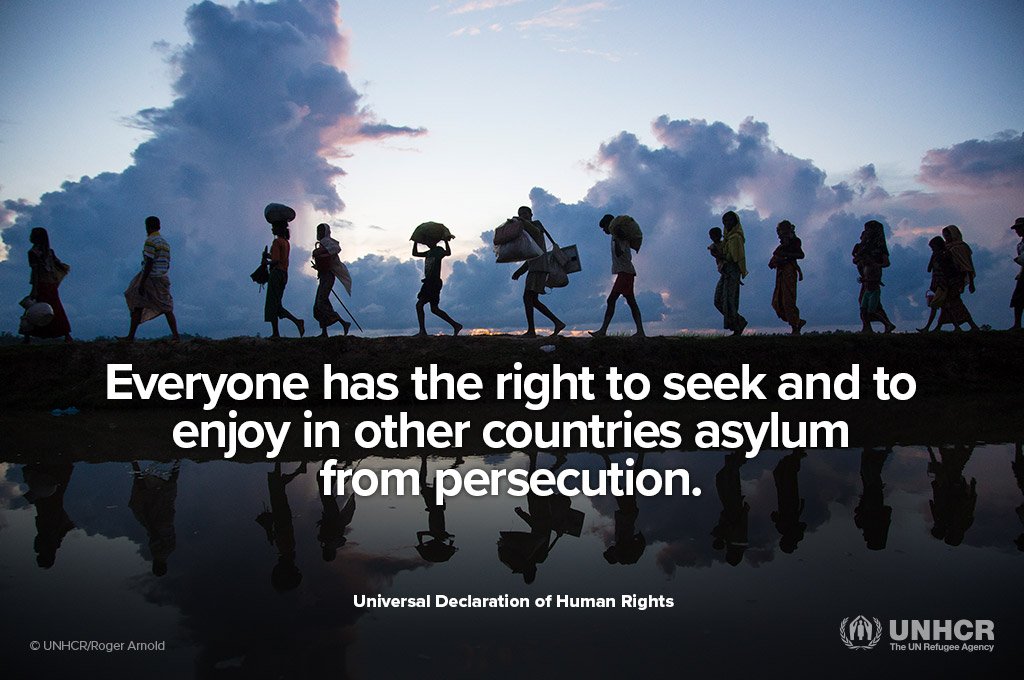
This requires a leap in the recognition of human rights to all including those who are asylum seekers and refugees. In this area, it is essential to question nations ratified to the 1948 Universal Declaration of Human Rights (UDHR)and the 1951 Refugee Convention. Thus a huge critique is about why these nations want to remain their political ideology that they see themselves obliged with terms such as liberal, demos and cratos, but eventually turns their back to asylum seekers and refugees. In order to demonstrate this narration, there are two main perspectives being considered. Firstly, each of the national pride must value the universal care about the rights of each of individual citizen in this nation and anyone who is working in this nation, and even seeking asylum in this nation. In the moral side, investigating only those who are asylum seekers and refugees as defined in the 1951 Refugee Convention, they are “owing to well-founded fear of being persecuted for reasons of race, religion, nationality, membership of a particular social group or political opinion, is outside the country of his nationality and is unable or, owing to such fear, is unwilling to avail himself of the protection of that country; or who, not having a nationality and being outside the country of his former habitual residence as a result of such events, is unable or, owing to such fear, is unwilling to return to it.” (Convention and Protocol Relating to the Status of Refugees, Article IA, p. 14) In addition, section 1 of Article 14 in the UDHR claimed, “ Everyone has the right to seek and to enjoy in other countries asylum from persecution.” By understanding and respecting to human rights, it is necessary to mention about forced displacement. New conflicts such as the Syrian civil war changing to the bombardment from the United State, Britain and France in the last couples of months ago aimed to the chemical weapon usage of the Syrian government, or the Myanmar Rohingya Crisis. Both cases are ongoing and increasing tensions to the heart of the humanitarian crisis, which the world is now witnessing. Can they seek asylum in a safer place? Can it be Australia, Europe and other better nations where the resettlement is humanly seen and accepted? This leads to the second query.

Secondly, having said about the international treaties and laws and signatories are nations in the world under the obligations of those papers, it is time to question how they perform and provide support to these documents. In response to this issue, author Nick Perre from Leiden University (Refugee Law Initiative, para. 6) argued that the so-called ‘refugee crisis’ or ‘migrant crisis’ does not manifest the increased influx of this true crisis for “one of the largest economic blocs in the world”, but it instead deals with “a crisis of solidarity.” This author also questioned about the EU policy and its intergovernmental, therefore current security policies about frontier protections and title such as “criminalising of migrants” can be seen in EU policy. While it is noticeable that the EU human rights laws also include in the 1949 Geneva Convention, in which “it requires human treatment for all persons in enemy hands, without adverse distinction.” (as stated in the Common Article 3) Besides, taking Australia as a typical modelled nation of multicultural pride alongside the refugee history of most people living in this nation. However, such policies as the “Pacific Solution” and the current “Operation Sovereign Borders”, and a range of agreed documents between the Australian government and other small islands like Nauru and Manus Islands, Papua New Guinea or Christmas Island, etc, are irrespective to the human rights laws and the obligations of any human rights treaties that Australia was a signatory. By all analysis, it illustrates a number of detrimental human rights practices violating laws and beyond the humanitarian of what we call the common good, which deserves to any individual rights as a human being.

The issue of the refugee is now the world issue. This demands urgent global attention the universal community engagement in advocating and recognising human dignity for all. It can be seen that since the World War II and its atrocity of making great loss to the heart of humanitarian, and the issue of refugee, which is now very much so-called the forced displacement storm, is evenly heart-wrenching and devastating the philanthropy of the one world nation where every human being shares the same ground. At the Article 35 of the 1951 Refugee Convention, it stated to co-operate with UNHCR in the exercise of its functions. Beyond the exceptions where the refugee is a threat to security or public order, Article 31 stated to no punishment with a refugee for illegal entry or presence. Article 32 that requires the Contracting States cannot expel a refugee and importantly shall not return a refugee to a territory where life or freedom is threatened as declared in Article 33 also follows this. Under this analysis, humanitarian assistance is a pathway for surrogate protection to the refugee crisis in the world. It requires nations like Australia, where successfully dedicated by the multiculturalism from migrants and asylum seekers and refugees, remains the good and its leniency of taking granted for the human flourishing to various communities living across Australia. Detentions are not serious but letting asylums for too long there is problematic and violating to the human rights, which seriously opposes the ground of the human dignity and the basic common good of all human beings. Shared responsibility is for all and so it not just to the government. It is better known that there are hundreds of thousand organizations such as the United Nations and its bodies, the Refugee Council of Australia, Oxfam, the Red Cross,… are contributing to saving the lives of children, women and men who are boat people and on the edge of death. Throughout the academic learning and teaching life, eradicating any suppression of voice to the understanding of desperate lives such as refugee must be recognised and put into series of actions by participating organizations amongst communities both locally and internationally to make real change to a life of one, lives of many. Because the work of us is to work together, a chain will be tied once it is recognised its important role to the whole system. Thus, it means that even small participation will be accumulated to appropriate help to many human lives such as the donations, which we give. Or, the voice that we make it heard and tells the government that we have the responsibility to ensure that asylum seekers and refugees are not irreparably harmed as a consequence of a lengthy period in immigration detentions. “Less is more” is very much like this.
Reference:
ICRC International Committee of the Red Cross 2010, The Geneva Conventions of 1949 and their Additional Protocols, viewed 21 May 2018, <https://www.icrc.org/eng/war-and-law/treaties-customary-law/geneva-conventions/overview-geneva-conventions.htm>
UNHCR The UN Refugee Agency, Convention and Protocol Relating to the Status of Refugees, viewed 20 May 2018, <http://www.unhcr.org/en-au/3b66c2aa10>
United Nations, Universal Declaration of Human Rights, viewed 20 May 2018, <http://www.un.org/en/universal-declaration-human-rights/>
World Economic Forum 2018, The Fourth Industrial Revolution by Klaus Schwab, viewed 20 May 2018, <https://www.weforum.org/about/the-fourth-industrial-revolution-by-klaus-schwab>
 The Digerati Politics