
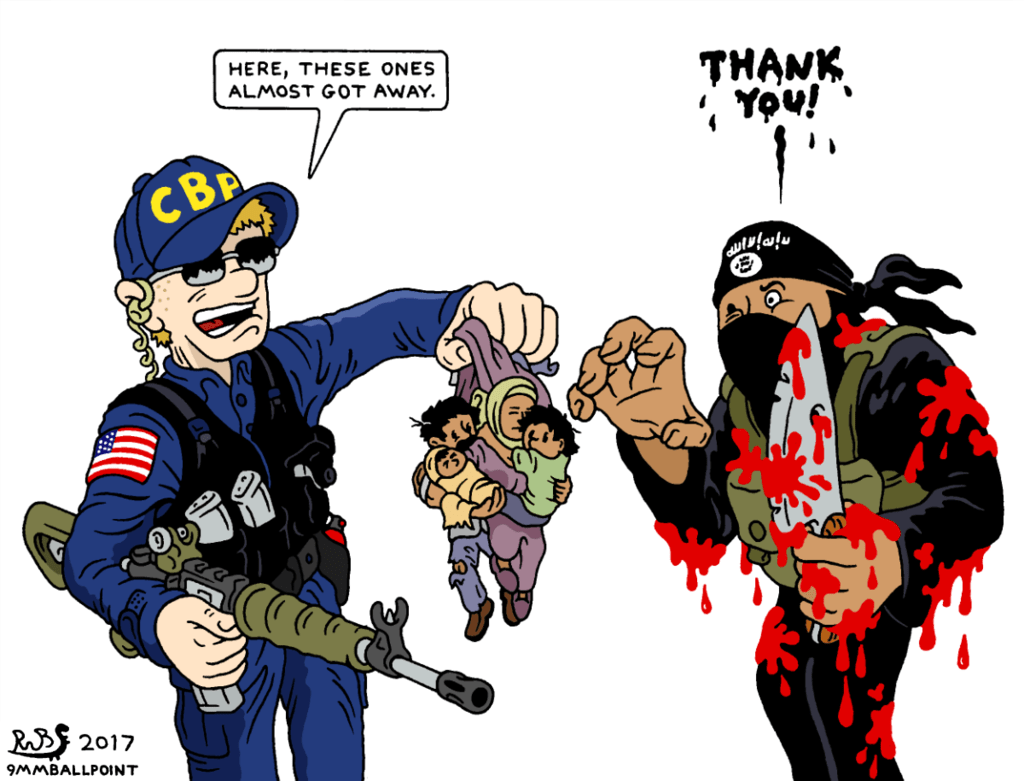
What is your answer when you are asked that what is the biggest fear, which you are afraid of, in the contemporary politics? This could be terrorism. In a broad view of security issue, war must be a term that no one in this globe wants it to be repeated. Especially after the tragic event of 9/11, as ranging from traditional state-centric security issues to new transnational security threats, and to broader issues of human security, one similar thing to war is terrorism. It thus increases the high awareness of people to believe that terrorist attacks or an attack on one’s town, or such invasion of a country by extremists are harmful events frightened to human societies such as greatest influenza pandemic killers: smallpox, measles, SARS, HIV/AIDS, or Ebola, etc. However, the discussion of this report is not to mention about the fear of diseases’ movement that human societies did face up with in the past centuries. Indeed, the politics of fear which international security in the central of the movement of people with an intensified and precarious level of terrorism. In this paper, one of the central issues in the contemporary international security issues – Migration and Border Issues in the 21st century will be examined within both traditional and non-traditional security theoretical perspectives, and the later part will propose several productive solutions in the correlations with human security and development in the global politics and the international security system.
According to the United Nations Department of Economics and Social Affairs (UN Refugees and Migrants 2018), an international migrant is defined with no formal definition and is agreed by most experts “an international migrant is someone who changes his or her country of usual residence irrespective of the reason for migration or legal status including temporary migration and permanent migration.” Though the rights of every individual in this globe are well-protected and reserved under the Universal Declaration of Human Rights 1948 and within other related doctrines in the development of the human societies, it is undeniable that massive movements of people challenge for the developed world while countries are places where problems about illegal immigrants, asylum seekers, refugees, diasporas and other migrants. Thus it naturally causes security and protection to the status of nation-states within their sovereignty rights as well. In the context of economic and political liberalism and of wider-spread globalisation, issues of migration are concerned reasonably from the removal of border in a multinational space, and the border protection in a secure and peaceful nation-state sovereignty itself.
Firstly, the world’s historical lessons of the 20th century have major influence within the concept of nation-state security and the protection of state values and citizens in traditional security studies perspectives. In terms of Realism, the common interests of nation-states are more concerns as core values, and allow a nation and its citizens working within its values and the development to be secured from outside attacks. In addition this was enlightened since the Peace of Westphalia (1648) and “realists consider the sovereign state as the principle actor in the international politics.” (Dune & Schmidt 2008, p. 92) This also claimed by many famous realist figures as Thucydides (c.460-406BC), Niccolo Machiavelli (1469-1527), Thomas Hobbes (1588-1679), and Jean-Jacques Rousseau (1712-78). For Hobbes (The School of Life 2015), “it is always better to have security rather than liberty in a country.” Thus he believed “sovereignty is instituted through the covenant by means of which individuals grant a person or an assembly the right to represent them.” (Spieker 2011, p. 191) Therefore to ensure the security of the state and the attempts in achieving security against attacks, it notifies the essentials of Realism including its family neorealism and neo-classical realism that is “a benign motive of survival” – which is to protect the national interests and to see states as key actors in the international system (Glaser 2016, p. 15-18). Agreed by Machiavelli in his book The Prince about the art of survival, the intention is to enable leaders to the power and the statecraft to protect his state at all costs (Dunne & Schmidt 2008, p. 101). With this in mind, building arm and military force in terms of border protection within border issues in the contemporary of the international security amongst nations is understandable and reasonably necessary. More importantly, according to Kenneth Waltz’s Theory of International Politics (1979) supposed that the anarchic system populated by states need ‘self-help’ principle. This is not only to provide the military preparations for unresolvable insecurities but also to those “who seeks to perpetuate themselves, alliances will be formed that seek to check and balance the power against threatening states.” (Ibid, p. 102) Lately, although Realism is no longer dominant in this contemporary politics, it seems inevitable and logic for both collective security systems and regional security communities. Having said that, the elusive security on migration and especially the movement of people from inter-states to intra-states is encroached and plays in the central debate of the international security issues.
Notwithstanding the Realism school of thoughts, the legacy of Liberalism and Neoliberalism and Idealism (Social Constructivism) makes most systematic critiques of migration and about the human security policies in respect with nation-states within one-another under the context of globalisation and the security lexicon. Before analysing the prominent ‘ism’ of the international security theories at the moment, many critics argue that Neo-colonial period has huge impacts on practices that “legitimize the violation of sovereignty in the Third World” including economic exploitations, cultural dominations and structures of violence, which hold back the prosperity of those nations and the human security. (Persaud 2016, p. 150) In addition, the world witnessed two historically deadliest war events, which are the World War I (1914/18) and the World War II (1939/45), and the Cold War and the proxy wars as the Vietnam War, the wars in Afghanistan, Korea, and many other places around the world in the 20th century. Those are seriously concerned in both academic and political discussion of how million military personnel mobilized in the wartime, and the huge detrimental civilians grown out of the human suffering and immense harm throughout internal country’s conflicts, wars, attacks from terrors, which the state-based response is no longer adequate especially after the WWII. For this reason, the human security and freedom of mobility had emerged and adapted in the Universal Declaration of Human Rights 1948. In the Article 13 of this document, it is stated that “(1) Everyone has the right to freedom of movement and residence within the borders of each state, (2) Everyone has the right to leave any country, including his own, and to return to his country.” Along with the Article 14, it is expressed that “(1) Everyone has the right to seek and to enjoy in other countries asylum from persecution, (2) This right may not be invoked in the case of prosecutions genuinely arising from non-political crimes or from acts contrary to the purposes and principles of the United Nations.” These are directly linked in the thoughts of the family of Liberalism. Dunne (2008, p. 111) indicated the theory of Liberalism, which is “government within states and good governance between states and peoples worldwide.” So this rectifies Realism that Liberalists do not see the international as an anarchic realm, but it looks for its core values within dimensions of order, liberty, justice, and tolerance in the table of the international relations. However, Dunne (2008, p. 110-114) also noted that the work of Kenneth Waltz’s Man, the State and War (1959) demonstrated that the Liberalism sphere see the causes of war in the fault of imperialism failing to seek the balance of power while others in under of undemocratic regimes, which opposed to the idea of the League of Nations for its collective security, where “a number of states join together in a collective response to aggression or an external threat”. This directs to the central issue of refugees and asylum seekers as part of the world’s biggest migration in the contemporary political debates regarding the human security and the human rights, the humanitarian crisis and the intervention. In facts, the course of Liberalism stretched many critical security issues regarding migrants in the value assessments in some countries like Europe, the US, Canada, and Australia. Dunne (2008, p. 117) claimed that the joint of the US with its allies, in a range of important international institutions such as the Bretton Woods system of economic and financial accords an the NATO security, shows ”the best examples of liberal hegemonic order between the abandonment and domination.” So this will on the one hand provide a look on the hegemonic power in extending and securing the common interests in the age of globalization; on the other hand it mobilizes the control of its institutions, markets (neoliberalism and privatization after 1980s), and resources. Thus the US statecraft and its foreign policies on the flows of migration are highly tied and institutionalized by the character of the American power since the post 1945 period til now. Nevertheless it is even more crucial in a different manner as under the Trump’s Administration currently and the American Dream to “Make American Great Again” coined by The US President Donald Trump. Thus he sees the building border and controls the border with Mexico and limit the flows of international immigrations are important to protect and secure the American values. While this issue may have some familiarities with the EU. As described by Williams and Peoples (2014, p. 168) following the WWII, the EU took a number of immigrant from India, Pakistan, and the Caribbean as to enter the workforce to rebuild the economic system, but it caused major threats to the EU public order, cultural identity, and domestic labour markets between low and high prices. The humanitarian crisis is still prevalent in this time within the EU. According to Perre et al. (2018), the European agenda on migration raises a number of concerns due to the security and value of the union and its member states, and it thus lets arguments escalated to top of the self-centred security issues linked with their political ideology of the past comprising of Populism, Eurocentrism, Xenophobia. While in Australia, amongst academic and political debates, migration policies on refugees and asylum seekers are controversial. Offshore processing, detention centres, the Pacific Solutions, the Operation Sovereign Borders are set up within agreements with other countries including Nauru and Manus Island, Papua New Guinea, and other places to deter the flows of undocumented or boat peoples from overseas entering to the mainland of Australia.
Having discussed the theoretical perspectives of international security between Realism and Liberalism and critical analysis of security theory, migration is still controversial to nation-states’ interests and the protection of citizenship. On one side, it is reasonable for a state (which Realism sees state as the central security perception) to construct the controls of borders within the border issues and migrants are seen as factors of threateners into the value assessments. On the other side, although the promotion of democratic states in the core of the international system is tremendous after the 1980s and the age of globalisation for every robust regimes, open markets, and institutions, non-liberal states or undemocratic states are still the privilege problem within the Liberalism, the added advantage has accepted the movement of people worldwide. However, attempts to secure the national interests and core values and the human development between the human rights and human security, the humanitarian intervention and human dignity have major influences in the international politics. The role of Idealism or Social Constructivism is put forward in the leading perception of the world’s politics within the promotion of peace and security studies among nations around the globe. The proposed concept of traditional security to the relation between state and individual are inalienable. However, the future of international security theory will succeed in a high demand throughout the world’s efforts in mutual understanding to the Social Constructivism and the security dilemma in the international relations.
References
Dunne, T 2008, ‘Liberalism’, in J Baylis, S Smith & P Owens (eds), The Globalisation of World Politics: An introduction to international relations, Oxford University Press, New York, pp. 108-124.
Dunne, T & Shmidt 2008, ‘Realism’, in J Baylis, S Smith & P Owens (eds), The Globalisation of World Politics: An introduction to international relations, Oxford University Press, New York, pp. 90-108.
Glaser, CL 2016, ‘Realism’, in A Collins (eds), Contemporary Security Studies, Oxford University Press, United Kingdom, pp. 13-28.
Peoples, C, & Vaughan-Williams, N 2014, Critical Security Studies : An Introduction, Routledge, London, viewed 19 September 2018, < https://ebookcentral-proquest-com.ezproxy1.acu.edu.au/lib/acu/detail.action?docID=1775297#>
Perre, N, Vries, M, Richards, H 2018, Refugee Crisis: three perspectives on the makings of a crisis, Refugee Law Initiative, School of Advanced Studies University of London, viewed 19 September 2018, <https://rli.blogs.sas.ac.uk/2018/04/16/refugee-crisis-three-perspectives-on-the-makings-of-a-crisis/>
Persaud, RB 2016, ‘Human Security’, in A Collins (eds), Contemporary Security Studies, Oxford University Press, United Kingdom, pp. 140-151.
School of Life 2015, Thomas Hobbes, viewed 18 September 2018, <https://www.youtube.com/watch?v=9i4jb5XBX5s>
Spieker, J 2011, ‘ Foucault and Hobbes on Politics, Security, and War’, Alternatives: Global, Local, Political, vol. 36, no. 3, 2011, pp. 187–199, viewed 19 September 2018, <www.jstor.org/stable/23210892>
United Nations Refugees and Migrants, Compact fro Migration, viewed 18 Spetember 2018, <https://refugeesmigrants.un.org/definitions>
United Nations, The Universal Declaration of Human Rights 1948, viewed 18 September 2018, <http://www.un.org/en/universal-declaration-human-rights/>
 The Digerati Politics