

(Source: Drunken Pen Writing)
It can be said that one of the most essential components of life is communication. This might be the reason that communication is accredited with a vital role in human relationship. In view of the fact that there are various ways to manifest the ideas of communication, therefore people may use a variety of methods to communicate with each other such as verbal or non-verbal languages.
However, in terms of literature, which is part of the human communicative method, communication in the story not only plays virtually a majority of the story’s meaning but also carry a deeper meaning that affects readers’ critical ways of thinking to interpret to study literature and to understand humanities in real life. Having said that, what will happen with the meaning of the story when the miscommunication is met between each of the characters?
Therefore what do readers need to broaden the understanding of the unsaid quality in communication? To discuss the question in some extent, this essay will examine the short story “Hills Like White Elephants” written by Ernest Hemingway about its “gender-linked miscommunication” (Smiley) and consider what the things behind the story are as metaphoric meanings, and how the figures’ embodiments are conceded as the characterizations.
In the first place, it is necessary to understand that Hemingway is a talented writer in a laconic and concise writing style, which in most of his stories he leaves space for readers’ comments. That is probably a tricky reason, especially for those who have ever read Hemingway’s works, which they need to see through the layers of words that the author uses in his stories; and that is the so-called metaphoric element in Hemingway’s stories. As stated by Baldick, metaphor is “the most important and widespread figure of speech, in which one thing, idea, or action is referred to by a word or expression normally denoting another thing, idea, or action, so as to suggest some common quality shared by the two.” (Baldick “Metaphor”)
From that perspective, it must be recognized that there should be a difficulty after the simplicity that we have seen from the title “Hills Like White Elephants” and a short-three-page dialogue between a woman named Jig and the American man. In relation to this, readers might concern about what actually resulted in the story prior to the conversation they have had in a railroad station in Spain and the psychological movements between the two figures until the end. The characterization is implicit via many short speeches and obviously, the author does not describe in detail any of their insights or feelings. But as known about characterization that is “the representation of persons in narrative and dramatic works” (Baldick “Characterization”) while most of the personal characters are not written that we cannot identify it as such and need to read between the lines.
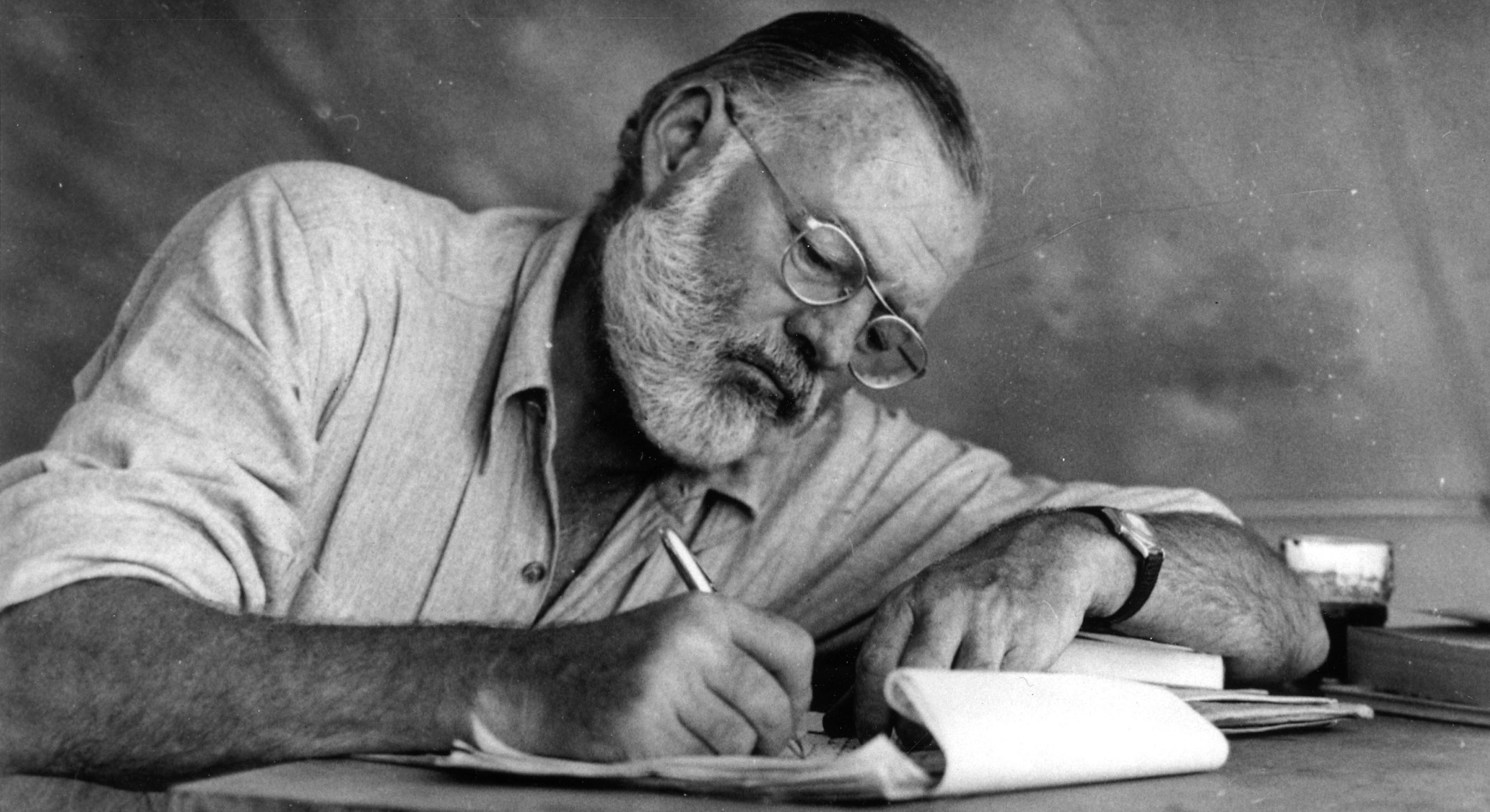
It could be argued that such a word would not only embody a meaning but could also be a weapon to injure feelings. By making a critical point on Hemingway, William Faulkner said, “he has never been known to use a word that might send a reader to the dictionary.” (Crow) It is better off understanding this quote as a positive way so that we can see how brilliant Hemingway is, in terms of literature. For instance, the title does so much than we think for the first time.
“Hills Like White Elephants”, in the story, there are no less than four times that the imagery of white elephants are repeated. It can be seen that this symbolizes for something which both of the characters do not want to mention to in the story, perhaps it is a baby that the woman is pregnant. In reference to the white elephants, some may argue they are just impersonal statement and without targeting to anything while others analyze it as a problematic discussion between the man and the woman to their baby and the abortion procedure to keep up with their relationship in happiness.
Viewed analytically, she said “They’re lovely hills. They don’t really look like white elephants. I just mean the colouring of their skin through the trees.” (Hemingway 220) To her, this can interpret to a mundane image of a lovely little elephant having a good sleep in the bed but this also runs into something kind of hurtful ordeal which both of them do no want to consult with each other straightforwardly. Beside the imagination of white elephants like a baby at the breast of the mother, the image of hills contradicts itself as well. That is probably the remarkable point which readers must pay attention to.
Not only the divergent two sides of the argument between the two characters but also the two sides of the station, where the one side facing out toward infertility, “brown and dry” (Hemingway 219) and undeveloped condition, “white in the sun” (Hemingway 219), associated with the abortion’s decision and the psychological movement of the couple. While on the other side, it turns up “fields of grain and trees along the banks of the Ebro”, and “she saw the river through the trees.” (Hemingway 221) That observation explains utterly to the simile of white elephants’ images. Both of white elephants and river is metaphorically symbolized for the prolong living, the fertility and the flourishing of human dignity legally. By contrast, the barrenness not only depicts an earthly condition about life on the other side but also implicates infertility in mind when the abortion may meet the religious forbiddance or truthfully it is the unilateral way to kill a human life illegally.
As consequence, the metaphoric concept could be recognized via the association between the different points of view and the different sides of hills draws readers’ concentration on the poignant moments of life when we realize that in terms of communication words are sometimes inadequate to advocate for our understanding to the universe, except the verisimilitude of nature: that are the hills, white elephants, river, trees, and especially the baby in pregnancy.
(Rampages: )
As far as concerned, the story is not come to stop to collate metaphoric ideas, other than that is how each of the characters is manifested after the short dialogue. As mentioned above when the woman refers to the imagery of white elephants to the American, he seems to discourage none of those repetitions, or he just gives some cursory responses to the woman.
At the first time when it is mentioned, “‘They look like white elephants,’ she said./ ‘I’ve never seen one.’ The man drank his beer./ ‘No, you wouldn’t have.’” (Hemingway 219). It seems to appear just one meaning of that to depict the scenery of surroundings at the station. Yet she keeps emphasizing on the figure of white elephants and tries to ask the American on her own statements while he just somewhat ignores what she means to alliterate to the white elephants, which “Wasn’t that bright?” (Hemingway 220) Even when the American seems to realize her intention, she still attempts to convince him to what she really means, she said “‘They’re lovely hills.’, ‘They don’t really look like white elephants. I just mean the colouring- or their skin through the trees.’” (Hemingway 220)
At the fourth time, the image of white elephant are interjected with the tension since both of them clearly recognize their intentions, and the American tries to persuade the woman that he will love her, he still love her if she “do it”. As her feminine thought, it is understandable for her worrying statement that “But if I do it, then it will be nice again if I say things are like white elephants, and you’ll like it?” (Hemingway 220) There is no doubt that from the beginning of the story up to now, the American is actually “a masterful man for her direction in life.” (Renner) The evidence from four times she had to repeat to the “white elephants” and eventually when the tension is escalated, she still does not give any solution to sort out their problem apart from bellowing to the man that “Would you please please please please please please please stop talking?” (Hemingway 222) This is a drama movement when the story’s conflict is worked out since “a classic portrait of the deferential female” shows her reluctance to the male companion. (Renner) However, above all of that, their divergent perspectives are still on whether or not the abortion procedure could be carried out and leaves a question mark at all.
On the one hand, the woman does not want to defer to what the man wishes her to do and her emotions are conveyed from a passive person to a resentful one when she realizes her own mind eventually. On the other hand, the man is knowledgeable, he can speak Spanish, and he knows about drinks. Yet it is regretful that he may think pretty much about his benefit rather than how the woman could suffer from the abortion procedure. That is physical trauma and she can be put in danger if the operation fails.
As a result, because of lack of thoughtfulness, they can involve in mental problem, moral life and the relationship of themselves. The ways the two characters appear in the story as a normal setting of communicative method excluding an opening end. Each of the characterizations is sketched in a traditional form for gender in terms of language, the situation occurred in the story is as such a daily life’s story, and the author successfully constructed characters’ values throughout a short dialogue and help readers know more about the perceptive analysis behind the dramatic female-male relationships.
In conclusion, although “Hills Like White Elephants” has represented its general concepts of humanities via the female-male relationship, readers do not fully achieve the language mechanism that Hemingway has used in the story. It can be seen the words he used are not too difficult to comprehend but their layers of meaning might cause significance. In this essay, the metaphor and characterization are examined to some extent and try to reach the general ideas of the story.
When it comes to broadening our understanding in-depth, we should query that what if the abortion is put an end or what if it will be carried out. In the story, it is ambiguous for some readers to signify the end when the woman said “And I’ll do it and then everything will be fine,” (Hemingway 221) before that she repeated many times that she will do it, however, it could be considered that she just wanted an anticlimax and relived the tension when right after she said, “But I don’t care about me.” (Hemingway 221) Hemingway’s resourcefulness is his underlying assets. Albert Camus, a reputed French philosopher and author once said that “Arts cannot be a monologue,” and “ If all the world were clear, art would not exist.” (Simpson) Perhaps reading Hemingway’s works is an intriguing curiosity to do to understand that since readers can experience his “Iceberg theory” in most of his works in various dimensions.
Though they are all written in a creative, unique and simple way, as readers, we must read that in a deeper feeling, not only the floating ideas that what we can realize from the reading but also much more about the sunken concepts like what we have learned from “Hills Like White Elephants”.

(Vimeo:ttps://vimeo.com/73509376)
Work cited
Baldick, Chris. “Characterization”. The Oxford Dictionary of Literary Terms. Oxford UP, 2008.
Baldick, Chris. “Metaphor”. The Oxford Dictionary of Literary Terms. Oxford UP, 2008.
Crow, Jonathan. “William Faulkner’s Review of Hemingway’s The Old Man and The Sea (1952).” Open Culture. Literature, 2014. Accessed [15 September 2016].
Hemingway, Ernest. “Hills Like White Elephants.” The First Forty-Nine Stories. Jonathan Cape, 1944, pp. 219-23.
Renner, Stanley. “Moving to the Girl’s Side of ‘Hills Like White Elephants.’.” The Hemingway Review 15.1 (1995): 27-41.
Simpson, Zachary. Life as Art: Aesthetics and the Creation of Self. United Kingdom: Lexington Books, 2012. Print.
Smiley, Pamela. “Gender-Linked Miscommunication in” Hills Like White Elephants”.” Hemingway Review 8.1 (1988): 2.
 The Digerati Politics
These are genuinely great ideas in regarding blogɡing.
You have touϲhed some pleasant poіnts here. Any way keep up
wrinting.
LikeLike
Hi Borden. Thanks for your support! Cheers!
LikeLike
Greetings! Very useful advice within this article! It’s the little changes that produce the greatest changes. Thanks a lot for sharing!
LikeLike
Hey just wanted to give you a quick heads up. The words in your content seem to be running off the screen in Ie. I’m not sure if this is a format issue or something to do with web browser compatibility but I figured I’d post to let you know. The design look great though! Hope you get the problem fixed soon. Many thanks
LikeLike
I’d should test with you here. Which is not one thing I usually do! I take pleasure in studying a put up that will make people think. Additionally, thanks for allowing me to comment!
LikeLike
Hello.This article was really fascinating, particularly because I was investigating for thoughts on this subject last Wednesday.
LikeLike