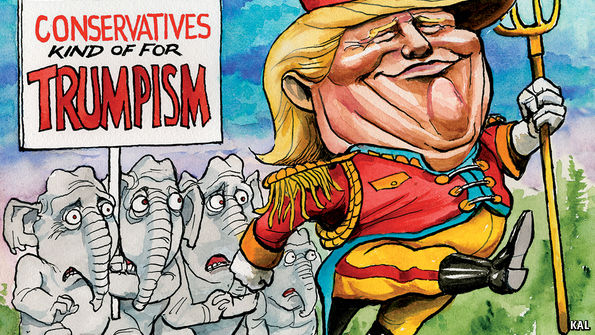
“Make America Great Again” has been being Trump’s motto since his candidacy for President in 2015 and the electoral movement in 2016, and it is still being a controversy in the dimension of politics worldwide. This 45th President of the United States has the promises and accomplishments with American to the continuing fight to put American First and American Dream, and the American people to be stronger, prouder and safer as its standstill history in the world. In the 21st century, this seems some things that at least people cannot call out the acute name of this political event, but it turns a driving force of the holistic political agenda to a new position amongst the world politics, which is the so-called Populism. The rise of populism in the mainstream of the political discipline matters to other political theories and the development of global solidarity and international diplomacy too. In this paper, the case of Trump will be examined of why it leads the Trumpism so pivotal to the concept of the country’s statecraft as same as the respect of Populism, and how this ideological stripe makes the political agenda from being fragmented inside (domestics) to the pivotal aim of building a globalisation of ‘the one world nation’ (international) and Trump’s Cultural Populism.
Firstly, it is malleable to accumulate why Trumpism as populism as the essentials to the whole ideology. From Cambridge Dictionary (Cambridge University Press, 2018), Ideology is explained as “a set of beliefs or principles, especially one on which a political system, party, or organisation is based.” The fact is that Trump was a reality television star and a billionaire with his renowned Trump Tower and inherited from his father Frederick Christ Trump who was an American real estate developer. In the newspaper “Making the man: To understand Trump, look at his relationship with his dad” (Michelle, 2016), the author reported that in Trump’s credited book “The Art of The Deal” he claimed in that “I learned from my father that every penny counts because before too long your pennies turn into dollars.” In this case, it touches the belief of what Trump expects that his presidency can contribute gratefully to all American people like what has made him become a billionaire and a politician. Obviously, it sounds understandable and Trump’s accomplishments can come true, and thus the actual result of his victory in the election is also the actual belief of the vast majority of American people. Or in other words, the rights of the people we decided the fate and have given the power to their elected president, and his works will, therefore, be understandable to support the effective protection towards the national economic system and his presidential term inextricably.
Nevertheless, commenting on the same newspaper’s headline “What is Trumpism?”, author Jon Sopel (2018, para. 2) rectified the aforementioned idea and supposed that there could have been a literal misconception to the Trump presidential campaign in 2016 by what the media just said, while it seemed a serious climate with between Trump and the public, which is in other words that “Trump’s supporters knew there were boasting and braggadocio to things he wouldn’t do and the sentiments.” In reality, Trump’s background and his excellency when he entered the political game happening in the United States in the contemporary globalisation makes people question about Trumpism from a person who is not a philosopher or intellectual in the political discipline, and instead, the “ism” seems to be a knot of the bigger want of the American people to whom they believe can make real changes to them. Internally speaking and ideologically, Trump’s ideations make explicit normative principles of populism as sovereignty and American First pragmatism like the late 15th-century political advisor and political theorist Niccolo Machiavelli and his holistic belief to a leader who is able to bring honour to the state and the management of it, or Thomas Hobbes and his work “Leviathan” published in 1651 about a conservatism to the national security rather than a liberty; and that they are all Realists under the peripheral Realism of the international relations and international politics, which opposed to Liberalism and Idealism (Constructivism). Therefore, that is to demonstrate the sovereignty of the US is continuing to be built stronger and prouder and safer under Trump’s presidency as his accomplishments too. In addition, committed to the American people and American Dream, Trump puts the notion of “The People” as a thickened ideology in terms of populism, while the elite isolated Trump with other groupings in the administration and even the statecraft of the US. In the basic administration and leadership, Trump’s slogan “Make America Great Again” is about to make him and his leadership a distinguished level to other previous presidencies. To the general will, it seems to oppose the leaderships of traditional political ideology. Notwithstanding, it is believed that most of every US presidents did work and contribute their heart to the great of the US and its people. But it lets us question about the international community in the dimension of foreign policy and where the bridge of globalisation leads to amongst the US and the political scheming across countries around the globe. Is this supposed countries’ foreign policies to change to adapt to the US’s bilateral and multilateral?
Thus, it is important to discuss the strategy by which a populist leader seeks ways to make his leaderships distinctively. Words from Wayland (2001, p. 14) that “a political strategy through which a personalistic leader seeks or exercises government power based on direct, unmediated, noninstitutionalized support from large numbers of mostly unorganized followers.” In Trump’s case, it identifies a number of unconventional ways of leadership. It seems very strong but it wastes a lot of money to support the latter works compared to other former presidents of the US. In other words, it is largely materialistic to the aspects of politics. As Business Insider Australia reported (Alan, 2018, para. 1), President Donald Trump spent more than $US850, 000 at his campaign, compared with $US565, 000 for Hilary Clinton in the 2016’s presidential campaign (Jeremy & Rachel 2016, para. 8) merely. Also, according to CNBC report, Ali (2018, para. 8) investigated that to date the organisation reported the Trumps reached “$US13, 533,937.28 in total first-year travel costs, each of a trip to the Bedminster golf club cost $15, 994 per hour, thus on a flight, the trip cost $44,783; two trips by Trump to Mar-a-Lago, including a trip where he met with Chinese President Xi Jinping, cost over $1 million., and about $206, 000 per hour of the presidential plan operation.” While this grand total was of $US114, 691,322.17 compared with Obama in his 8-year tenure in the same report. That is totally incredible and shocked to what money and politics hard to separate and explain in this strategy. Moreover, a series of Trump’s policies such as concerning about the white supremacy, Xenophobia, immigration enforcement, infrastructure investment (building the wall in the border with Mexico), trade and the war trade with China, tax reform, the economy, the foreign policy (withdrawing from the TPP, the Paris Climate Change Agreement (especially the relationship amongst Asia, Euroasia, and the allies. It seems odd to any conventional political types between the benefits and drawbacks. In the contemporary, it is somehow questioned by most of the scholars and the international political science disciplines about what Trump and the Trumpism will be looked like in the end because of the unconventional political strategy in terms of populism compared to the pure politics or the art of the state. Is this looked the same with “The Art of The Deal?”
By contributing two aspects of populism including ideology and strategy of populism, it is such a discussion of there is no “one-size-fit-all” in this world of politics. While traditional politics have more abstracts and the way it is going to lead the world order of the Idealist, some others believe in a non-juxtaposition between the external world of politics and the internal approach of the people. Having said that, populism has given a just explanation of the central point from which populist leaders are both advantageous and disadvantageous in world politics, and hard to predict the future.
As Mudde et al. (2017, p. 27) wrote about the populism considered for some as “a challenge to the functioning of contemporary democracy politics”, and others may be like an “indicator of problems with politics”, or “a radical and empowering force.”
References:
Cambridge Dictionary 2018, Cambridge University Press, viewed 29 August 2018, <https://dictionary.cambridge.org/dictionary/english/ideology>
Dean, M 2016, Making the man: to understand Trump, look at his relationship with his dad, The Guardian, viewed 29 August 2018, <https://www.theguardian.com/us-news/2016/mar/26/donald-trump-fred-trump-father-relationship-business-real-estate-art-of-deal>
Montag, A 2018, President Trump’s travel costs now total over $13 million, right-leaning Judicial Watch reports, CNBC Politics, viewed 31 August, <https://www.cnbc.com/2018/01/20/trumps-travel-costs-during-his-first-year-exceed-13-million-dollars.html>
Mudde, C & Kaltwasser, CA 2017, ‘What is Populism?’, in Populism: A Very Short Introduction, Oxford: Oxford University Press, pp. 1-20.
Peter, JW & Shorey, R 2016, Trump Spent Far Less Than Clinton, but Paid His Companies Well, The New York Times, viewed 30 August 2018, <https://www.nytimes.com/2016/12/09/us/politics/campaign-spending-donald-trump-hillary-clinton.html>
Smith, A 2018, Trump campaign has now spent more than $850, 000 since last year at his properties, Business Insider Australia, viewed 30 August 2018, <https://www.businessinsider.com.au/how-much-trump-campaign-spends-at-properties-golf-courses-2018-7?r=US&IR=T>
Weyland, K. 2001, ‘Clarifying a Contested Concept: Populism in the Study of Latin American Politics’, Comparative Politics, vol. 34, no. 1, pp. 1–22.
 The Digerati Politics
Nice post. I was checking continuously this blog and I am impressed! Very useful info particularly the last part 🙂 I care for such info much. I was seeking this particular information for a long time. Thank you and good luck.
LikeLike
Hi, Dupree! Thanks for your kind words! Have a great day!
LikeLike
Howdy! Do you know if they make any plugins to safeguard against hackers? I’m kinda paranoid about losing everything I’ve worked hard on. Any suggestions?
LikeLike
Hi, Bryan. I unfortunately have not used the plugins. I will check it out and learn it more. So same there indeed!
LikeLike