

Crisis & In what ways?
This year – 2018 has marked one decade since the Global Financial Crisis (GFC) in 2008. The event has fuelled the flame after one of America’s largest investment banks – Lehman Brothers collapsed. This was seen as the second biggest panic threatening the entire global financial markets and banking system after the bankruptcy of the Wall Street Crash or Stock Market Crash 1929-1933, which also then signalled the 12 year-long of the Great Depression. As Stephens (2018, para. 1) stated that the legacy of the GFC might have been “a re-imagination of the market economy.” This can be seen as one of the indispensable nature of event after a crisis in order to settle down the micro and macro values belonging to a nation’s political, economic and social system. In other words, it urged to reform.
Thus the political spectrum including the politico-social and politicoeconomic branch had to be re-projected to heal the financial wound with their people, who had suffered from financial losses with a downward of the status-quo, and unemployment situations. In answering the ad hoc scenes of the GFC, scholars across the world have seen one thing so-called “The Global Rise of Populism” and its revolutions fuelled the flame right at the GFC. Moffitt (2016, p. 1) supposed the populist times are currently coming to life from “the Eurozone sovereignty-debt crisis” to “a crisis of faith in democracy.”
In similarity, Knight (1998, p. 2) considered that populism exacerbated as “an unconscionably long time dying”, and it now returns “like the living dead of Latin American politics, to haunt the sentient world, undeterred by the bright dawn of democracy.” At this time, from Brexit (triggered in 2016) to Trump (elected as the POTUS in 2016) has demonstrated a future of world politics since the rise of populism. Hence, a question of “in what ways the GFC contributes to the rise of populism” is broadened to answer. In this paper, there will be three aspects looking into the insight of the GFC and their connection to the global rise of populism. It includes the rising unemployment rates densely in various regions is seen as precondition which leads to populism to the majority of working-class people; the event of the economic crisis has uncovered shortcomings in the design of European economic and political institutions and the rise of political extremism, and the populist demand for reform in the name of “the people” manifests an external trigger between the reciprocal relationship of political crisis and populism, and the financial system in its recession time.

Firstly, the rise of populism in the GFC time and its legacy in the contemporary politics in many regions of the world has been preconditioned because the ‘hard-working classes’ so beloved of politicians were the victims of the crash. The hallmark of the intelligent reform then naturally takes into account for populist leaders to bring back justice and rights of the people. Aglan et al. (2017, p. 310) claimed that the roots of populism and this crisis is because “the unemployment dynamics have been uneven” with increased amounts from 7 percent in 2007 to 11 percent in 2013 in the EU-widely economic impact since the GFC.
The authors also detailed the percentages of the unemployment rates such as in 2008-09 Germany to feel to pre-crisis levels and above 20 per cent in Greece and Spain; besides the continuing impacts hanging the postcrisis are fluctuated in the demonstrations such as the lower of 5 percentage points in the unemployment rate in the UK in 2016 compared to 2007, while Northern Greece’s unemployment in 2012–14 hovered around 30 per cent due to tourism mitigated the shock of the crisis; and Italy’s unemployment in 2012–15 ranged from 6 to 7 per cent in the North (Trento, Veneto, and Friuli-Venezia Giulia) to above 20 per cent in the South (Campania, Calabria, and Puglia).
In another aspired volume, authors Kriesi and Pappas (2015, p. 1) included three intertwined dimensions of the economic crisis due to its competitiveness crisis caused by the slowdown growth at this moment in the EU’s economic system, the banking crisis due to its lack of transparency under the capitalisation process, and the sovereign debt crisis because of the rising bond yields. It seems the connection of the central banks and the financial regulations in relation with the unemployment crisis did not interact smoothly and caused social inequalities.
It then naturally had the rights for the powerless people to oppose devilish elites including the wealth (either bankers or industrialists) and politicians. Kriesi and Pappas (2015, p. 1) supposed that this was the reason why populist leaders rose and skyrocketed the electoral success.
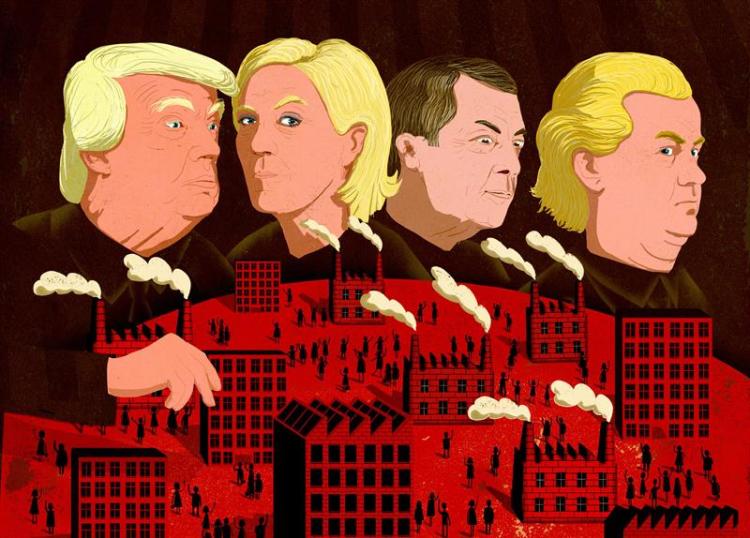
Source http://hrmagazine.co.uk/article-details/office-politics-the-rise-of-populism-and-hr
Secondly, populism uprisings have lingered in the systemic shortcomings of the design of European economic and political institutions and the rise of political extremism. Giving an explanation for this, it is noticed to the two types of political populist leaders from right-wing populism and left-wing populism. In this environment, da le Torre (2016, p. 61) said that left-wing populist candidates (like Hugo Chavez, Evo Morales, and Rafael Correa, major populist leaders in Venezuela, Bolivia, and Ecuador respectively), “resurrected the leftist utopias of revolution and socialism,…and emerged as a resistance to neoliberalism.”
The institutions are believed to be controlled by traditional parties perceived as instruments of local and foreign elites, who implemented neoliberal policies and thereby increased social inequality. Besides, Mudde (2016, p. 297) emphasized that the three different ideological features (nativism, authoritarianism, and populism) are often interconnected in the propaganda of the parties, but as mainstream political parties they are accused of “ignoring immigrant crime” (and/or political correctness) and of “favouring immigrants at the expense of the native people.”
Analytically looking at the definitions of each of the populist politics, it correlates the meaning of populism so as to the definition of “the people” is in the mainstream of the political ideology’s. However, the people are not always narrowed itself, but it takes another dimension so-called “the pure people”.
Similarly, the elite can sometimes be called “the corrupt elite”. Mudde (2016, p. 297) continued to rectify the perception about immigration in the populism understanding, and he explained that nativism is just to tell the distinction between the “natives” and the “aliens”, but the populist division itself also considers “the people” and “the elite” within the native groups. To reflect it on the idea of economic and political institutions, Taggart (2000, p. 4) viewed that populism’s ambivalence about politics “gives rise to a sense of crisis amongst the social group…by simplicity and plain-talking of ordinary people, but it limits itself because of its attitude towards institutions.”
Eventually, it gives the crisis a meaning of what economic benefits that “hard-working people” in the middle class (bourgeois) or lower or ordinary people can earn from. Thus, the fear of rich and poor will be difficult to change and the financial regulations in terms of policy-makers will struggle with the political vague terms under the rise of populism. In addition, Funke and Trebesch (2017, p. 6) showed evidence of right-wing populist parties, like in the election of Donald Trump in the US and the Brexit vote in the UK, are particularly thrived, as they entered parliaments and, in some cases, government are “the most recent culmination of the rise of populism in the Western world.”

Source https://www.careerfaqs.com.au/news/news-and-views/unemployment-and-the-global-financial-crisis
Lastly, the populist demand for reform in the name of “the people” manifests an external trigger between the reciprocal relationship of the political crisis of populism and the financial system in its recession time. As mentioned above about the economic benefits for whom, it is probably ideal for populist leaders to be inspired. Nevertheless, the association of populism and economic “irresponsibility postulated” by Sachs (cited by Weyland in Ostiguy et al. 2016, p. 51). Weyland (2016, p. 51) also precisely claimed: “a new wave of political populists embarked on orthodox adjustment and thorough market reform” (Carlos Menem in Argentina, Fernando Collor in Venezuela, and Alberto Fujimori in Peru) systematically applied populist strategies and tactics to boost their political leadership, but at the same time “enacted comprehensive programs of neoliberal reform in close consultation with the global sheriffs of economic orthodoxy, the International Monetary Fund and the World Bank.
These “unexpected affinities” of populism and economic liberalism (Weyland 1996, p. 4-15) showed that populism cannot be interpreted through the disregard of neoliberal principles such as budget discipline and monetary equilibrium due to the characteristics of neoliberalism such as wage cuts, dismissals of state employees, and privatization of public enterprises. Moffitt (2016, p. 144) also argued that relationship between populism and crisis should be thought in both ways which “crisis acts as a trigger of populism” and “populism attempts to act as a trigger for crisis.”
From those perspectives, neoliberalism and its main characteristics can put a halt in the populism platform where populist leaders could not find a political logic when it comes to the crisis merely. In other words, Laclau put bluntly (cited by Moffitt 2016, p. 115) claimed that “the crisis of presentation … is at the root of any populist…and it does not emerge or succeed without crisis spurring it into existence.” In sum, the reciprocal relationship between market reform and populism are generated by each other, which can be seen as a benefit.

Source https://www.ft.com/content/687c0184-aaa6-11e8-94bd-cba20d67390c
In conclusion, the GFC 2008 is one of the best cases representing an insurgent force, which directly targeted the political scrutinization of the governments over the financial regulations including under-regulated finances and significant inequalities with their people; and the people acted their political rights to urge their government to deal with the economic shocks fairly. Populism adopted as the uprisings to not only the central banks or policy-making decisions from financial regulations, but it also acted as juxtaposition along with the economic reform across the world. Thus, that demonstrates a reasonable contest in answering the crisis and its influences concerned by elite insiders and general public role in the political mainstream over the central bankruptcy due to the GFC during the neoliberal era and the political debates in the contemporary politics in the world.
References:
Aglan, Y, Guriev, S, Papaioannou, E & Passari, E 2017, The European Trust Crisis and the Rise of Populism, Brookings Papers on Economic Activity, , pp. 309-400, viewed 2 November 2018,< http://dx.doi.org.ezproxy2.acu.edu.au/10.1353/eca.2017.0015>
De la, T 2016, Left-wing populism: Inclusion and authoritarianism in Venezuela, Bolivia, and Ecuador. The Brown Journal of World Affairs, vol. 23, pp. 61-76, viewed 2 November 2016, <https://search-proquest-com.ezproxy1.acu.edu.au/docview/1862999706?accountid=8194>
Funke, M & Trebesch, C 2017, Financial crises and the populist right 1. DICE Report, vol. 15, no. 4, pp. 6-9, viewed 2 November 2018, <https://search-proquest-com.ezproxy2.acu.edu.au/docview/1993303922?accountid=8194>
Knight, A 1998, ‘Populism and Neo-Populism in Latin America, Especially Mexico’, Journal of Latin American Studies, vol. 30, no. 2, pp. 223-248, viewed 1 November 2018, <http://www.jstor.org.ezproxy2.acu.edu.au/stable/158525>
Moffitt, B 2016, The Global Rise of Populism, Stanford University Press, California.
Mudde, C 2016, ‘Populist Radical Right Parties in Europe Today’, In Transformations of Populism in Europe and the Americas: History and Recent Tendencies, London: Bloomsbury Academic, pp. 295–307, <http://dx.doi.org.ezproxy1.acu.edu.au/10.5040/9781474225243.ch-016>
Stephens, P 2018, Populism is the true legacy of the global financial crisis, Financial Times, viewed 1 November 2018, < https://www.ft.com/content/687c0184-aaa6-11e8-94bd-cba20d67390c>
Taggart, P 2000, Populism, Open University Press, Buckingham.
Weyland, K 1996, ‘Neopopulism and neoliberalism in Latin America: Unexpected affinities’, Studies In Comparative International Development, vol. 31, no. 3, viewed 3 November 2018, <https://doi-org.ezproxy1.acu.edu.au/10.1007/BF02738987>
Weyland, K 2017, ‘Populism: A Political-Strategic Approach’, In The Oxford Handbook of Populism, Oxford University Press, <http://www.oxfordhandbooks.com/view/10.1093/oxfordhb/9780198803560.001.0001/oxfordhb-9780198803560-e-2>

