
What is “urbicide” and, according to Adam Jones, what role did it play in the Cambodian genocide? – Giving a brief commentary.
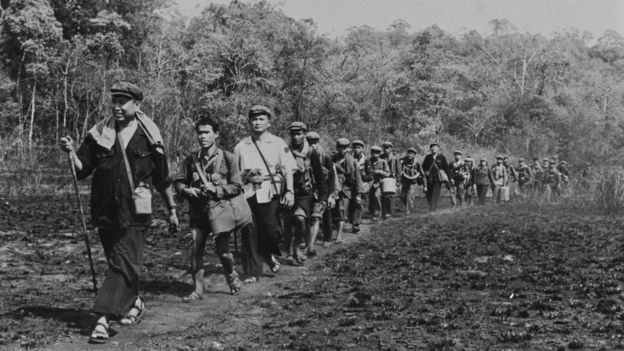
Khmer Rouge (KR) and its genocide were laid in world history as one of the most horrific atrocities with massive killings of peoples of groups in Cambodia (Kampuchea). In the understanding this, a genocidal ideology has been created to help explain why and where the KR got its philosophy of their genocidal program. That includes “Hatred of enemies of the people, Xenophobia and messianic nationalism, Peasantism, anti-urbanism, and primitivism, and Purity, discipline and militarism”.[1] However, to make the ideology practical to understand, the policy of “urbicide” was invented and politicized to construct a distinct form of violence.
According to Jones, the term urbicide was constituted by “the annihilation of cities as mixed physical, social, and cultural spaces.”[2] From this perspective, it can see the way of constructing policy in terms of the genocidal program as means of destruction of the built environment of cities. Therefore, it represents an extreme disruption of urban areas like what the KR viciously did with its citizens.
The brutality of this policy causes a lot of questions of why the leaders of the KR could think urbicide to guillotine those civilians and deviants. The role of urbicide in the Cambodian genocide was then used to depopulate those living in urban areas, which considered as antiurban or urban bias. With ideological outlook, KR leaders like Pol Pot who was French-educated and got great influence from French communism and orientalist thinking. The observation from historical events from Vietnamese Viet Minh or the Chinese Cultural Revolution made Pol Pot ideologies too distinctive to fight wherever he thought there were American vestiges. Subsequently, it turned out deadly cities or ghost towns with no one could remain their life because of the urbicide and genocide. “New people” then took place the cities, which Jones pointed out that they were “considered the lowest in the village structure, and have no rights except to obey other classes.”[3] This was nothing rather than a dictator regime and turned to crimes against human rights.
Bibliography
Jones, Adam. “Chapter 7: Cambodia and the Khmer Rouge.” In Genocide: A Comprehensive Introduction, 283-309. Hoboken: Taylor and Francis, 2010.
[1] Adam Jones, “Chapter 7: Cambodia and the Khmer Rouge,” in Genocide: A Comprehensive Introduction, (Hoboken: Taylor and Francis, 2010), 290.
[2] Ibid.
[3] Ibid.
 The Digerati Politics
Greetings! Very useful advice in this particular article! It is the little changes that will make the biggest changes. Many thanks for sharing!
LikeLike
This is a terrific blog, will you be involved in doing an interview regarding how you developed it? If so e-mail me!
LikeLike
Glad I detected this on google .
LikeLike