
Commentary: What the world out there is something or many things that abide at our unknown tails. Are you able to guess it peace or not peace?
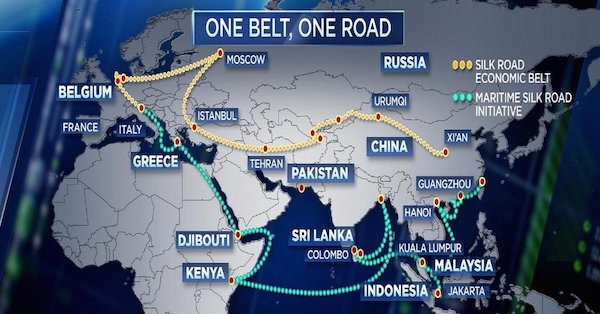
Pakistan’s new highway, Kazakhstan’s new rail terminal, Sri Lanka’s recently opened seaport, or Laos’ new bridge are belonging to a one country’s project, which spans three continents including Asia, Africa and Europe, and has a huge impact on the great majority of the world’s population. This is China’s One Belt and One Road Initiative (OBOR)– one of the most ambitious infrastructure projects in the modern world since the Marshall Plan founded by the United State President Truman in 1948 that was used as a means of providing economic assistance to reconstruct the infrastructure of the European countries after the World War II. However, the OBOR project has hesitated the world with the question why the breathtaking ambition to build a vast network of trade routes from East to West is being provoked again since the ancient “Silk Road.”
In a famous book of The Origins of Political Order, cited in Chapter 7, author Francis Fukuyama (2012, p.110) critiqued about “War and The Rise of the Chinese State” that “how the Chinese state arose out of military competition; Shang Yang’s modernizing reforms; the doctrine of Legalism and its critique of Confucian familism; why political development was not accompanied by economic or social development.” Are there more implications rather than this Initiative? Whether or not the trade corridor is the core plan of the Belt and Road Initiative (BRI), the corridor of power seems to be the rubble of the whole OBOR picture that the world is worrying about. Scholars in many dimensions have supposed this as an autocracy promotion through the OBOR from which China “peacefully” seek its way to rise again, not only in terms of geopolitical manifestation but also a strong influence on the international order. This paper will follow the worrying point of scholars about BRI to investigate the autocracy promotion of the Chinese government in assessing (1) the Xi’s Thoughts on Socialism with Chinese Characteristics for a New Era” in the constitution of the Communist Party (CPC), and (2) ‘New Silk Road’ and China’s hegemonic ambitions. Two of the main aspects briefly ignite into the political ramifications of the BRI, hereby the autocracy promotion being justified beyond the concern of the economic infrastructure connectivity.
At glance, the term One Belt One Road Initiative is not new but it is rather developed from the ancient “Silk Road”. According to the UNESCO (2019, para. 1), ‘Silk Road’ is termed by a German geologist, Baron Ferdinand von Richthofen in the mid-nineteenth century for the holistic network of the trade and communication in German Die Seidenstrasse. Throughout history, the Silk Roads was functioned as the link from East to West for the purposes of communication routes and paths of trade. However, from the 1st and 2nd century BC “the networks carried more than just merchandise and precious commodities, however: the constant movement and mixing of populations also brought about the transmission of knowledge, ideas, cultures and beliefs, which had a profound impact on the history and civilizations of the Eurasian peoples.” (UNESCO 2019, para. 2) Therefore, the OBOR or BRI being seen today is the legacy of ancient Chinese history. In modern time, the re-birth of OBOR given by the current Chinese President Xi Jinping in the fall of 2013. The confusion of the name OBOR is not the whole discussion, it should be the major elements included. Griffiths (2017, para. 4) pointed out two major parts of the initiative consisting of “Silk Road Economic Belt” with the whole spectrum of road infrastructure and trade projects; and “21st Century Maritime Silk Road” with the shipping network and sea-based lanes for the development of ports throughout Asia and the pacific. In other words, it links the western China to Central Asia and Europe from the overland; while the sea-lanes connect China to Southeast Asia and the Middle East (Population and Development Review 2017, p. 583). Such terms Belt and Road ventured from the past to become a driving force for outstanding economic cooperation and integration across a vast region and the extension of China overland. Is this the merely single focus of the initiative? Are there factors of rapid power consolidation and the foreign relations of China through this? The project is not a company’s plan but is rooted in a government planning out of its mainland to the world. It is thereof the autocracy promotion generating through a big economic infrastructure project.
According to Oxford Advanced Learner’s Dictionary (Wehmeier et al. 2005, p. 88), autocracy is defined in the uncountable noun as “a system of government of a country in which one person has complete power,” and in the countable noun as “a country that is ruled by one person who has complete power.” While promotion of something is defined as “activity that encourages people to believe in the value or importance of something, or that helps something to succeed.” (2005, p. 1208) In an affirmative way of interpretation, autocracy promotion can be understood as an activity that a system of government of a country encourages people to believe in the value or importance of one person’s complete power, or that helps the value or importance of that power to succeed.
Of all the understandings, the autocracy promotion of the Chinese government through the OBOR Initiative makes a political sense and it is necessary to envisage the rationale of the political ideology of the CPC by assessing the Xi’s Thoughts on Socialism with Chinese Characteristics for a New Era” in the constitution of the Communist Party (CPC). After Mao Zedong Thought and Deng Xiaoping Theory, Xi Jinping has been the third leader of the CPC to be honoured the name in the Constitution and to be called Xi’s Thought as the philosophical resource of the charter. This is given a reasonable performance because it adheres to the Preamble of the Constitution of the People’s Republic of China (PRC). It says “China will be in the primary stage of socialism for a long time to come. The basic task of the nation is to concentrate its effort on socialist modernization along the road of Chinese-style socialism.” (The State Council 2004, para. 5) On the other hand, in many media channels, Xi and his speeches try to embody the signature foreign policy theme of his leadership, from which he calls “China Dream”. This is, however, difficult to understand in the absence of a thorough scrutinization of the Chinese Communist Party (CCP) foreign policy recognition. Johnston (2017, p. 5) who is the Senior Adviser and Freeman Chair in China Studies in the Centre for Strategic and International Studies supposed that “the practical embodiment of “China Dream” for promoting national rejuvenation and cementing the country’s place as a leading world power.” Gan (2017, para. 3) extracted speech of Xi from the 19th National Congress that he said: “government, the military, society and schools, south, east, and west – the party leads them all.” This was tighter than the 18th National Congress in order to approach his governance over the congress by having successfully lobbied the abolishment of the term limits for the presidential and vice-presidential positions. In discussing the Meritocracy, Mark (2018, para. 1) commented on this that “Xi Jinping now looks set to join the ranks of other populist authoritarian leaders like Turkey’s Recep Tayyip Erdogan and Russia’s Vladimir Putin who have used constitutional means to consolidate authoritarian power.”
Eventually, a closer look at the accelerating socialist modernization, this can be the new historical circumstances and the political proclamation of the CCP. From the central leadership, in the 18th National Congress, Xi stated, “we should uphold the socialism with Chinese characteristics… and the Congress has called on the whole party to explore and master the laws of socialism with Chinese characteristics, ensure that the Party is always full of vigour and that China never lacks the driving force for development, and that we must strive for a bright future for developing China’s socialism.” (Xi Jinping The Governance of China 2014, p. 4) Therefore the road of Socialism is deeply concerned in the ideology of the CCP and the relations of China and foreign countries in order to achieve “Socialism with Chinese Characteristics for a New Era”. Gou (2013, p. 280) reinstated this such of political ideology from Mao to Deng that in post-Mao China the charismatic “strong man” model and “collective decision” characterized at the top of the political structure (the CPC Politburo Standing Committee), and thus “a gradual transition in any key foreign policymaking is still made by the top leadership.” In other words, this has influences into Chinese foreign policy-making structure and process. The OBOR is thereafter an underlying geostrategic component, which the world reasonably fears about under the directive leading role of the CCP. Whether the autocracy promotion is part of the OBOR or not, the ideology of this Socialism of Chinese characteristics has confused the world in many dimensions throughout the economic and political understanding.
Having discussed the authoritarian regime and the affirmative role of Socialism in China, it is comprehensive to understand the ‘New Silk Road’ and China’s hegemonic ambitions behind the OBOR. In details, after the Beijing summit of OBOR in 2017, China’s official rhetoric about the initiative has been highlighted. However, according to Wolf (2017, para. 4) “the summit failed to allay concerns about Beijing’s bilateralism, a lack of transparency, and the corruption issues related to OBOR.” This may not be ideal to the CCP. However, Xi himself proposed just hope and diplomatic words rather than a clear strategy that suits nations in the EU, for instance. In Xi Jinping The Governance of China (2014, p. 81), he expressed “I hope you will make full use of your advantages to strengthen connections and exchanges between China and other countries, acting as unofficial ambassadors to promote people-to-people friendship, and explaining China’s culture, history and points of view in such a way that the people from other countries can understand and identify with China, and be ready to give it greater appreciation and support.” However, Buckley (2018, para. 18) considered the differences between Mao and Xi so that Xi’s Thought still “reverses the teaching of Mao and Karl Marx but links to even older Chinese traditions, especially Confucianism”, while Mao in the revolution he once said he “wanted to smash the grip of Confucius on China.”
The use of Chinese ancient civilization to the modern world with the thriving of modernization and globalization discussions; what Xi and the language of his party want to be delivered is controversial. Thus the connectivity of China and the EU is still missing its dialogue platform. Wolf (2017, para. 24) expressed that “the EU economic actors have a fair chance to compete for business through open, transparent and non-discriminatory procurement procedures with Chinese competitors. As long as China doesn’t make an effort to bridge the gap between OBOR and different EU approaches, move toward multilateralism, and address the EU values based on good governance, the rule of law, human rights and democracy, scepticism regarding OBOR will persist.” In another investigation, Martin (2010, p. 1) thought “another complicating factor is the propensity of PRC officials at all levels of government to render Machiavellian interpretations of provisions in the national constitution.” This is also pointed out that the highest organ of the state is the National Party Congress (NPC) in relation with the aforementioned of central leadership, and then Xi can be the “Prince” of the East in the understanding of Machiavellianism. Subsequently, whether the opaqueness of this state can be seen as Xi’s strategy through OBOR, “PRC politics as they play out with respect to particular policies or issues.” (Martin 2010, p. 2) In addition, a U.S Senator, Chuck Grassley (2018, para. 11) concerned over the “debt-trap” diplomacy of the CCP, and he stated once again from Xi’s speech in the 19th NPC “China’s development does not pose a threat to any other country. No matter what stage of development it reaches, China will never seek hegemony or engage in expansion.” This Senator supposed this is a false statement and the imperative goal for the BRI is “the creation of an economic world order ultimately dominated by China” because of the financial hostage force ransoms under its geostrategic goals. Notwithstanding, the CPC’s Vision and Actions on the Jointly Building Silk Road Economic Belt and 21st Century Maritime Silk Road (2015, para. 11) proclaimed, “The Initiative seeks mutual benefit. It accommodates the interests and concerns of all parties involved, and seeks a conjunction of interests and the “biggest common denominator” for cooperation so as to give full play to the wisdom and creativity, strengths and potentials of all parties.” Overall, this is contested and difficult to be the attention of developing countries as the feel of China’s hegemony and the new Silk Road project is not a clear plan after the Beijing summit 2017. The hegemony ambition this is contested, which means that it can be true or not really at some points. The seeking of cooperation that promotes common development and prosperity through OBOR is, then, contested as well.
In brief, dimensions of OBOR understanding are varied due to the plan itself are opaque. Theories can be contested but introducing a national plan with non-transparency of bilateralism or multilateralism is hard to convince it is a peaceful and mutual plan. OBOR is a huge economic integration and cultural inclusiveness due to its geostrategic and geopolitical effects. As a result, Xi Thought and the New Vision of OBOR happening in the twenty-first century is still debatable and this paper does not take any advantages to collaborate the propensity of its connectivity to the world by judging it is wrong or reasonable rather than watching the future steps of OBOR in the relations with the world politics and justice and fair-go for all nations across the globe.
Reference list
Johnston, C.K 2018, President Xi Jinping’s Belt and Road Initiative: A Practical Assessment of the Chinese Communist Party’s Roadmap for China’s Global Resurgence, Centre for Strategic & International Studies, viewed 23 May 2019, <https://www.csis.org/analysis/president-xi-jinping%E2%80%99s-belt-and-roadinitiative?fbclid=IwAR1aMya7KZf8MekMjbm2wtQE2ORVbOQeadMpE5SzpVPBx_wrz6g4x-Ai44g>
Gan, N 2017, Xi Jinping Thought – the Communist Party’s tighter grip on China in 16 characters, South China Morning Post, viewed 23 May 2019, <https://www.scmp.com/news/china/policies-politics/article/2116836/xi-jinping-thought-communist-partys-tighter-grip-china>
Guo, S 2013, Chinese Politics and Government: Power, Ideology, and Organization, Routledge, NY.
Grassley, C 2018, Senators Express Concerns over China’s “Debt Trap” Diplomacy with Developing Countries, Chuck Grassley United State Senator for Iowa, viewed 23 May 2019, <https://www.grassley.senate.gov/news/news-releases/grassley-senators-express-concerns-over-china-s-debt-trap-diplomacy-developing?fbclid=IwAR3ZZuzNToS2udw6swzNCywWm1-eUvuuwgMcfMKkdokrpc0ZYNRflNhETIs>
Griffiths, J 2017, Just what is this One Belt, One Road thing anyway?, CNN International Edition, viewed 23 May 2019, <https://edition.cnn.com/2017/05/11/asia/china-one-belt-one-road-explainer/index.html>
Mark, C 2018, China’s Political Meritocracy Under Xi Jinping, The Philosophical Slon, viewed 23 May 2019, <https://thephilosophicalsalon.com/chinas-political-meritocracy-under-xi-jinping/>
Martin, M.F 2010, Understanding China’s Political System, Congressional Research Service.
Population and Development Review 2017, ‘China’s “One Belt One Road” Initiative: An ESCAP Report’, Wiley Online Library, vol. 43, no. 3, pp. 583 – 587, viewed 23 May 2019, <https://onlinelibrary.wiley.com/doi/epdf/10.1111/padr.12089>
UNESCO 2019, Silk Road: Dialogue, Diversity & Development, viewed 22 May 2019, <https://en.unesco.org/silkroad/about-silk-road?fbclid=IwAR1nufiCL2kksser1uE_qPcDtBom75XfO4uq-hHVF0h4jpB7-stGVLV2wgA>
PRC National Development and Reform Commission, Vision and Actions on Jointly Building Silk Road Economic Belt and 21st-Century Maritime Silk Road 2015, viewed 23 May 2019, <http://en.ndrc.gov.cn/newsrelease/201503/t20150330_669367.html?fbclid=IwAR2gQfNkq_VmihioHoRE9BmS-t96ImLizZ6FdYYXlObXZgcn43Dxq2qVXBE>
Wehmeier, S, Mclntosh, C, Trunbull, J, & Ashby, M 2005, Oxford Advanced Learner’s Dictionary, 7th edn, Oxford University Press: UK.
Wolf, S.O 2017, ‘New Silk Road’ and China’s hegemonic ambitions, DW, viewed 23 May 2019, <https://www.dw.com/en/new-silk-road-and-chinas-hegemonic-ambitions/a-38843212>
Xi Jinping The Governance of China 2014, The Foreign Press, China, viewed 23 May 2019, <http://www.bannedthought.net/China/Individuals/XiJinping/XiJinping-TheGovernanceOfChina.pdf>
 The Digerati Politics
I was very happy to discover this website. I wanted to thank you for your time just
for this fantastic read!! I definitely appreciated every bit of it and I have
you bookmarked to look at new stuff on your blog.
LikeLike