

There is really no understanding of the American political culture without race at the centre of it. Whether or not the definition of slavery is vanished out of our modern life, a variety of political transitions and reforms, it makes us question at the contemporary politics of race happening in the US. Have some fraudulent definition exchanges tried to calm us down to think about race and the fact of inequality of some communities? Michelle Alexander (2012) has argued that the so-called “war on crime” was and is part of “the New Jim Crow.” In this piece of writing, it agrees with the given perspective by the scholar and fortifies some angles of arguments.
A brief history of the “Jim Crow” Laws
If the presidential elections can give us a comprehension of political partisanships to explain about divides or polarization within the Republicans and the Democrats, the politics of race will be explained from civic perspectives thoroughly. Exactly, one is rolling inward the political ideologies, and the other is rolling out the sore problem that this nation is facing. Currently, the tragic George Floyd death due to the over policing has been one of the least examples that we can think of.
That this is problem of the colour backless, which rooted in the history of slavery in America during the 17th until mid-19th centuries – time of the Founding Fathers. The drawbacks of colour blackness in the American politics held in the Jim Crow Laws occurred from the 1880s into the 1960s, a majority of American states enforced segregation through “Jim Crow” laws (so-called after a black character in minstrel shows) (National Geographic, 2020).
The chronological history of racial segregation in the United States from the end of the Civil War to the passage of the 1964 Civil Rights Act. Since the election of the first Republican President – Abraham Lincoln’s Emancipation Proclamation in 1863 and the 13th Amendment ratified in 1865 to abolish slavery (often referred to black communities) in the Constitution. In 1964, President Lyndon B. Johnson signed the Civil Rights Act, which legally ended the segregation that had been institutionalized by Jim Crow laws.

War on Drugs & the New Jim Crow
The War on Drugs is a phrase used to refer to a government-led initiative that aims to stop illegal drug use, distribution, and trade by dramatically increasing prison sentences for both drug dealers and users. The movement started in the 1970s and is still evolving today.
From Nixon’s law and order rhetoric, and his ‘southern strategy’ – the war on drugs was an asymmetric war in which poor, young black men were increasingly targeted, to the Presidency of Ronald Reagan (1981-89), “New Deal policies limited black welfare participation and institutionalized racialized welfare restrictions, and Civil rights gains have done little to alter the strength of the race-policy relationship.” (Brown, 2013, p. 395)

It traces in the speech of Lee Atwater (Perlstein, 2012), campaign strategist to Ronald Reagan, once said: “You start out in 1954 by saying nigger, nigger, nigger. But 1968 you can’t say nigger, that hurts you. It backfires. So, you say stuff like force-bussing, state’s rights and all that stuff. You’re getting so abstract now. You’re talking about cutting taxes. And all of these things you’re talking about are totally economic things… And the by-product of them is blacks get hurt worse than whites.” If it has one word to describe this, from mass-incarceration to mass media coverage, a fear contextualization is created to dominate the people and array a series of justification from the government to suppress and cover the truth. What was behind the scenes? Are they all black criminals? Or the whites too? Wacquant (2014, p. 42) pointed out that “it is a figure of speech, which hides the multiple filters that operate the point to the penal dagger.”
Comparing the prison population
In 1971, 96 persons were imprisoned for more than a year for every 100,000 persons in the general population. Ten years later (1981) the incarceration rate had risen to 154 inmates per 100,000 population, rates for men and women were 303 and 12, respectively (Bureau of Justice Statistics, 1982)
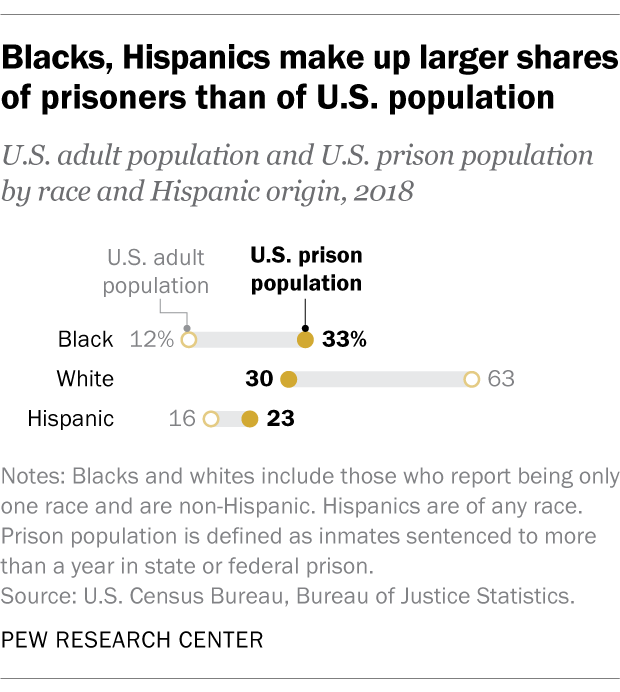
In 2020, according to the Pew Research Centre (Gramlich, 2020) found that although the imprisonment rate has fallen, there are still outnumbers amongst Black inmates (33%) than their Hispanic (23%) and white counterparts (30%). Besides, Alexander (2012, p. 99) studied the National Institute on Drug Abuse and the National Household Survey on Drug Abuse since 2000 and drew attention that white students used cocaine and heroin at seven times, while eight times for crack cocaine higher than black students, and white students from age 12-17 were the most likely possessed and sold illegal drugs than black students.
While public perception of police brutality and racial bias in the Criminal Justice System play a central heat in debating democracy in the US, there is an obvious disparity in how the public view fatal encounters between police and Black people. 66% said these encounters were isolated incidents, according to the National Association for the Advancement of Coloured People (2020, para. 7)
- 84% of Black adults say white people are treated better than black people by police;
- 63% of white adults agree based on 2019 research on police relations.
- 87% of Black adults say the U.S. criminal justice system is more unjust towards Black people; 61% of white adults agree.
- Even though more white people have been killed by police, Black and Hispanic people are disproportionately impacted.
- While white people make up a little over 60% of the population, they only make up about 41% of fatal police shootings.
- Black people make up 13.4% of the population but make up 22% of fatal police shootings.
Alexander (2012, p. 97-103) also pointed out that “Drug crimes rather than violent crimes are responsible for the majority of imprisonment in the US rates of illegal drug use and drug sales are not materially different between black and white Americans. But black men 13 times more likely to be imprisoned in a state prison than white men:
- 1 in 14 black men behind bars in 2006, compared to 1 in 106 white men
- 1 in 9 black men between 20-35 years old behind bars”
In brief, the socio-political effects of contemporary racial divides risk the health of the American politics. Also, the demise of de jure discrimination “has done little to diminish the centrality of race in American politics” (Brown, 2014, p. 395). Whether it is post-civil rights and colour blindness in America, a social dilemma like this prescribes an overdose in policing, militarising and even weaponizing to treat people in colours in general, especially the black communities. Unfortunately, the argument of Michelle Alexander (2012) is sharply evolving until now in 2020.

References:
Alexander, M. (2012). The New Jim Crow: Mass Incarceration in the Age of Colorblindness. The New York Press. pp. 97-139.
Brown, H. E. (2013). Racialized Conflict and Policy Spillover Effects: The Role of Race in the
Contemporary U.S. Welfare State. American Journal of Sociology. Vol. 119: 2. pp. 394-443.
Criminal Justice fact Sheet. (2020). National Association for the Advancement of Colored People. Retrieved from: https://www.naacp.org/criminal-justice-fact-sheet/
Gramlich, J. (2020). Black imprisonment rate in the U.S. has fallen by a third since 2006. Pew Research Centre. Retrieved from: https://www.pewresearch.org/fact-tank/2020/05/06/share-of-black-white-hispanic-americans-in-prison-2018-vs-2006/
Perlstein, R. (2012). Exclusive: Lee Atwater’s Infamous 1981 Interview on the Southern Strategy. The Nation. Retrieved from: https://www.thenation.com/article/archive/exclusive-lee-atwaters-infamous-1981-interview-southern-strategy/
Prisoners In 1981. (1982). Bureau of Justice Statistics. Retrieved from: http://www.bjs.gov/index.cfm?ty=pbdetail&iid=3366
The Black Codes and Jim Crow Laws. (2020). National Geographic. Retrieved from: https://www.nationalgeographic.org/encyclopedia/black-codes-and-jim-crow-laws/
Wacquant, L. (2014). Class, Race and Hyperincarceration in Revanchist America. Socialism and Democracy. Vol 28:3. pp. 35-56.
 The Digerati Politics
Fascinating blog! Is your theme custom made or did you download it from somewhere? A design like yours with a few simple tweeks would really make my blog shine. Please let me know where you got your theme. Kudos
LikeLike
Howdy just wanted to give you a quick heads up. The text in your post seem to be running off the screen in Internet explorer. I’m not sure if this is a format issue or something to do with browser compatibility but I thought I’d post to let you know. The style and design look great though! Hope you get the problem resolved soon. Kudos
LikeLike
Hi Kudos. Your comment is great and I know perhaps the problem is lying at the format. This is due to my current layer of the web is not fully business concept. Therefore, the search engine may not reach out this page content. In the coming time, this issue will be fixed. Thanks, heaps! have a good day! 🙂
LikeLike
Oh my goodness! Impressive article dude! Thank you so much, However I am having issues with your RSS. I don’t understand the reason why I am unable to subscribe to it. Is there anybody getting the same RSS problems? Anybody who knows the solution will you kindly respond? Thanks!!
LikeLike
Superb blog you have here but I was wondering if you knew of any user discussion forums that cover the same topics discussed here? I’d really like to be a part of online community where I can get feed-back from other experienced individuals that share the same interest. If you have any suggestions, please let me know. Thank you!
LikeLike
updated with the most up-to-date gossip posted here.
LikeLike
I see something genuinely special in this site.
LikeLike
Hello. remarkable job. I did not expect this. This is a splendid story. Thanks!
LikeLike
I love what you guys are up too. This kind of clever work and reporting! Keep up the good works guys I’ve included you guys to my personal blogroll.
LikeLike